Showing posts with label experiences. Show all posts

Tuesday, April 23, 2013

Gatecrashing the Ed Damer boys’ club

Rooftop shisha den in Ed Damer.

Since returning to Ed Damer after an almost two-month absence, the time has passed in a whirlwind of social events, lunches, invitations and even a random wedding. I’ve barely had time to catch my breath.

While my visiting my friend Inayat today, we were joined by my teaching colleague Ahmed, who is also her relative.

As we sit down to a light meal together, Ahmed urges me to eat quickly as he wants to invite me for a coffee. I was slightly intrigued, but assumed he was bringing me to his family home as Ed Damer isn’t exactly over-run with cafes and the tea ladies that frequent the souq are off-limits to women.

Bidding Inayat farewell, we take off at a brisk pace towards the centre, with Ahmed’s small talk at almost the same speed. I’m having trouble keeping up on both fronts when we enter the gate of a nondescript white building. Ahmed pauses finally and explains that we are entering a Naadi (men’s sports club). He tells me that although Sudanese ladies cannot enter, it's no problem for me since I am a foreign woman. 

Although I’m hesitant, the idea of entering a forbidden zone is somewhat beguiling.

We climb a narrow, darkened staircase, arriving at a rooftop 'bar' serving juice and the usual assortment of tea and coffee. The only other women are two Ethiopian tea ladies. Men sit in large groups, smoking shisha and chatting. Inside a small adjoining hut, football blares from two TV screens.

It's decidedly downmarket; the outside bar furnished with little more than a haphazard assortment of plastic chairs, low tables and large, glass shisha pipes, positioned on the grimy floor next to each group.

Ahmed points out other neighbouring shisha dens from the balcony, explaining that such clubs operate under semi-legitimacy, as smoking shisha is periodically banned by the government and is still frowned upon by some sections of society.

The other men almost fall off their chairs when I enter. In fact, for a moment, I think some of them actually will. They look like they couldn't be any more surprised if a green alien had suddenly sat down in their midst and ordered coffee. Although it's not overcrowded, I cannot remember ever feeling more conspicuous or scrutinised than I do at this point.

None of the men make any pretence to hide their stares and when I move closer to the balcony for a moment to see the view, I feel every pair of eyes follow me.

Ahmed is one of the few male colleagues and acquaintances that I have met in Ed Damer that I feel comfortable around, with others tending towards veiled advances. In fact, if anything, he behaves with an almost exaggerated politeness and formality towards me.

I wonder aloud whether my reputation in Ed Damer will survive in tact after being seen in a place of such ill-repute, but he waves away my concerns.

“Anyway, you are a foreign woman. You shouldn’t mind for such things. You are quite free”, he says.

Foreign or not, I have to admit that it feels good to throw off the shackles of what I ‘should’ or shouldn’t be doing and, despite the intensity of attention I’m attracting, being in that half-forbidden place, suddenly feels liberating.

I tune out the eyes boring into me and start to enjoy the atmosphere around me. Although it is still light, the sun is beginning to dip below the roof tops and somewhere in the distance the guttural evening call to prayer rumbles to life. A mute Palestinian man with matted dreadlocks passes the tables, begging money with a bizarre imitation of a sideshow clown. As part of the act he tweaks his nose, earlobes and nipples, emitting a high-pitched squeak as he does so. I'm rather relieved when he moves on to the next group.

At the same moment, Ahmed conversely bemoans the lack of entertainment options in Ed Damer, saying the shisha bars are among the few social outlets available.

Although he’s a regular at the bars, Ahmed tells me it is the first time he has brought company. He says his close friends don’t approve of shisha smoking and that he prefers to sit alone from the other clientele – a rough and tumble mix of construction workers, desert nomads and camel traders.

Ahmed orders jebana for me - the sweetly spiced coffee sipped from tiny cups - and settles back in his chair to smoke.

“Since you are my friend, I want to speak freely to you, to tell you about my problems,” he begins by way of conversation, before launching into a detailed explanation of his latest marital woes.

Ahmed’s first wife and love of his life died in childbirth and he later remarried a second time to a woman he had three children with and is now divorced. He has another two children with his current wife.
Coffee with a lot of attention

Having recently reconciled with his second wife, he has decided he wants to remarry her so that he can bring his children together under the same roof. This news infuriated his third wife, who promptly packed her bags and moved back into her mother’s house with their children. He has not seen or spoken to her or the children in three weeks. 

He tells me he is shocked by her “bad” behaviour and angry reaction and asks for my opinion on the matter. As I explain to him that for most women the idea of sharing a husband is an untenable situation, regardless of what religion or tradition dictates, he listens intently, ruminating on my words as though I am offering him the holy grail of a happy home and marriage. But I wonder if he can really be that clueless about his wife’s feelings.

In any case, Ahmed tells me he still wants to forge ahead with plans to remarry in June, even if his idea to bring his families 'together' means the destruction of his existing relationship.

The story only adds to my general confusion about the nature of Sudanese relationships, which seem to be conducted at turns with an idealistic romanticism and a staggering business-like impersonality.

I sip the last of the coffee, feeling the delicious hot liquid go straight to my head, like an electric jolt. We head back down the same darkened staircase, leaving behind the men's stares and the billowing, perfumed smoke. On our way out we pass a uniformed guard asleep on a rope bed near the front gate still clutching a half-full cup of shai in his hand ...


Wednesday, February 20, 2013

Three weddings and a hidden bride

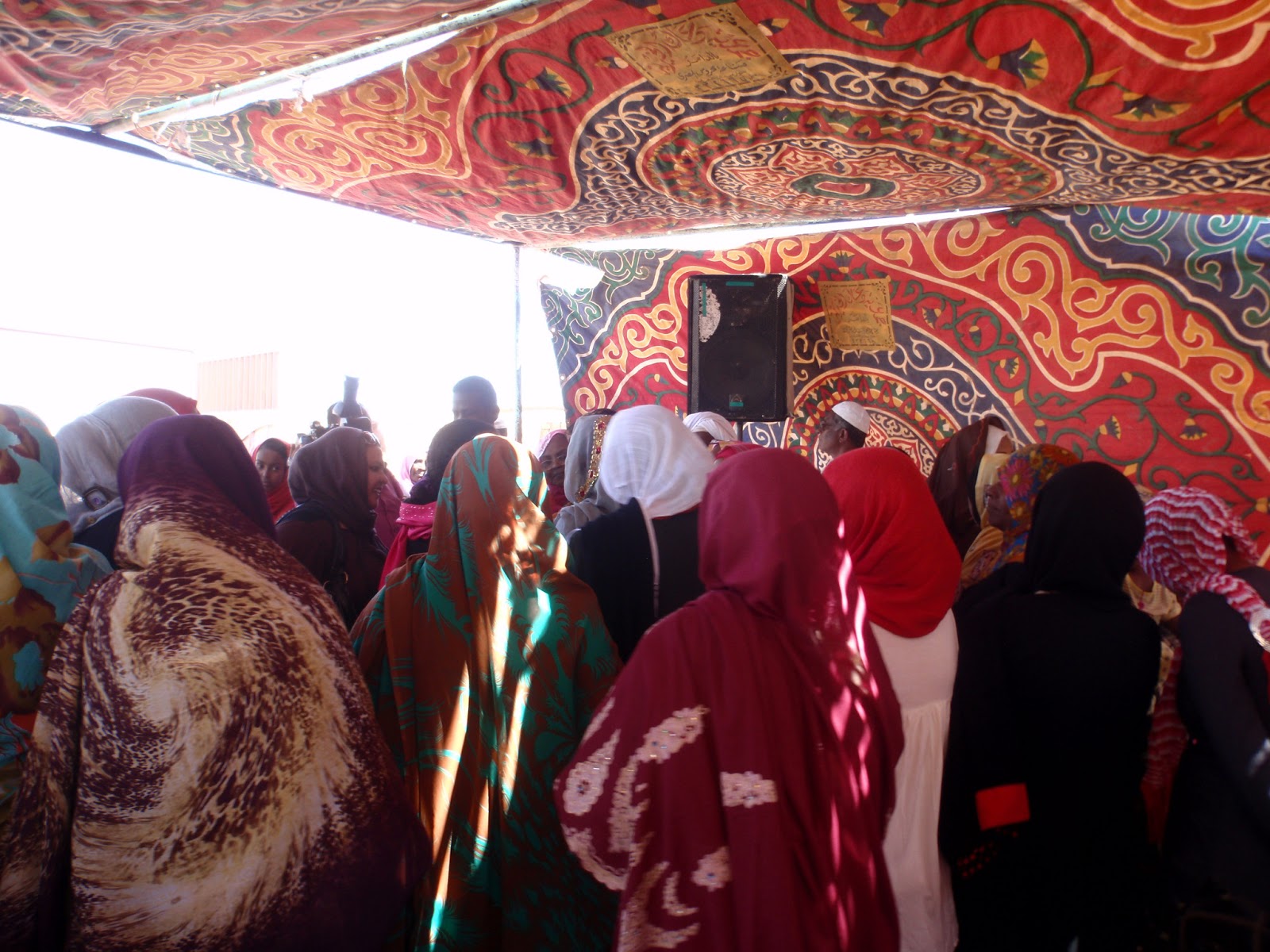
I strode across a dusty field set up with an outdoor marquee, acutely aware that all eyes were focused on me. In line with the segregation that pervades everyday life in Sudan, women sat on one side, while the men sat on the other – in an indistinguishable sea of white jellabiyahs and turbans. It reminded me of a high school dance, with the opposite sex eyeing each other shyly from a safe distance.

I had never met the bride or groom before and nor do I even know their names.

I had arrived as part of a mixed group, but in an apparent concession to our foreignness our hosts seated us together in a middle section so we could still chat. A small tray of sweets, popcorn and dates was immediately placed in front of us by way of welcome.

Let the dancing begin …

The music restarted and the guests got to their feet – the strict lines of gender demarcation suddenly blurring on the dusty dancefloor as women shimmied in their elegant tobes, clicking their fingers in time to the music, encouraging those that lingered on the sidelines.

The same women, who had looked at me with stony expressions when I entered now took me by the hand and dragged me to the dancefloor, but to tell you the truth I was happy to be part of the movement and celebration.

The older women are the most bold, cutting a path through the throngs with their considerable girth, clicking their fingers in my direction and shaking their shoulders in a sort of dancefloor greeting. The younger ladies are more sedate, shuffling on one spot, their eyes cast downward.

The ubiquitous wedding videographer manouvers his giant black camera in my direction, black leads trailing behind and in the next moment I'm looking up at myself in giant colour on the bigscreen.

Men in freshly starched jellabiyahs circle the perimeter in a coordinated shuffle, waving large sticks in the air at those sitting within the circle. Some wear sheathed swords at their hips and and others are carrying whips.

The men are fleet footed and graceful, leaping elegantly up and down like white gowned puppets on a string, hanging for a moment suspended in mid-air. It is a wonderful sight to watch.

‘It’s young, isn’t it?”

The car carrying the bride and groom arrives and is immediately mobbed. The band strikes up a gorgeous melody and the crowds begins to sway in time, surging closer and closer to the car until it is totally surrounded. They wave their hands, pumping their fists and sticks in the air above the chaotic crush  - it’s an intense moment. The women’s joyous wailing fills the air, carrying above the music. Even by Sudanese wedding standards, I’ve never seen anything quite like it in terms of sheer exuberance.

The song has almost finished when the bride and groom finally emerge from the car. The man looks happy, but bashful in his black, ill-fitting suit. The bride stares fixedly at the ground. She is wearing a modern-style wedding dress, with her hair hidden under an elaborate Islamic headdress. I am immediately struck by how tiny she is, her small body enveloped by her billowing white dress.

A women in a blue tobe next to me whispers to me in English “the bride is 14, the groom is 27.” It’s young, isn’t it? Too young”. I’m still digesting this rather disturbing news when she grabs my hand and we join the frantic procession behind the bride as she makes her way inside to her new husband’s family home.

When we enter the bride is slouched unsmiling on a lounge chair. Up close, the ghostly white makeup and garish purple eye shadow only seem to magnify her youth.

Breathless masha allahs emanate from her adoring audience. She looks like she’d rather be anywhere else than at her own wedding.

My companion pushes me through the crowd, urging me to greet the bride. I bend down close to her, “mabrook” (congratulations), I murmur as I offer my hand. She doesn’t meet my eyes and her handshake is so light our skin barely touches. “Young, very young,” my companion whispers in my ear again, shaking her head again for emphasis.

Hidden from view

The crowd closes around the young bride and that’s the last I see of her for the rest of the evening. I’m later told she comes from a particularly strict family and accordingly she must remain inside the house, hidden from view.

Outside her husband has lost his bashfulness and is waving a whip as he is carried around the circle on the shoulders of the men, the women trail behind clicking their fingers.

The groom passes by a line of young men, individually whipping them on their chests while they attempt to remain unflinching - a custom traditionally carried out as a symbolic test of bravery for male suitors trying to impress potential sweethearts.

The celebrations continue in full swing with more whipping, more dancing and wailing. At one point I’m pulled to the centre of the crowd to dance with the groom. He holds both ends of his whip in his hands and loops it over my head as we move in time to the music. My awkward movements again captured on bigscreen.

This was one of the most vibrant weddings I have attended so far in Sudan, but the celebrations are tinged by the hard realities of the occasion. It is not only the bride's youth and obvious reticence, but her invisibility.

I can’t help but wonder if she feels any sense of unfairness about her situation as she remains cloistered inside the house, while everyone else celebrates her marriage in her absence.

Marriage of contrasts

The following week I’m spontaneously invited to another wedding – my third in as many weeks.

Although the surroundings are more upmarket and the dancing more restrained, many details are almost identical. The segregation of the sexes, the finger clicking, the overloud band and omnipresent camera man.

On an elevated stage behind two disused car seats have been decorated with tinsel to form a sort of kitsch marital throne.

The bridal car arrives and is immediately mobbed by the crowd. But this is no early, arranged marriage. The bride is a 28-year-old working professional and her husband is in his 30s, her brother explains.

The couple emerge from the car and are embraced by their family. The band resumes playing.
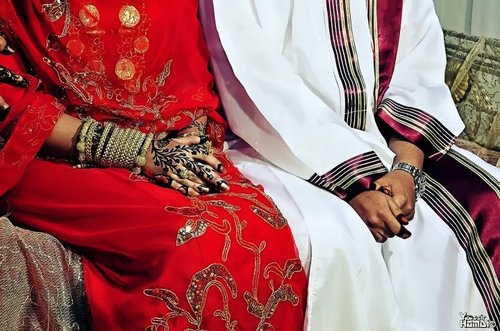
The bride dances at her husband’s side, clicking her fingers lightly in time to the music. She wears white lace gloves, magnifying the elegant dark lines of her henna tattoos.

When her husband is carried off on the top of the men’s shoulders, she is immediately encircled by female relatives and friends eager to offer their congratulations and compliment her appearance.

Even as the bride stares downwards, avoiding direct eye contact with a mixture of coy shyness, there is no hiding her obvious delight.

The couple remain on their feet dancing until the celebrations are exhausted, their elaborate throne remaining unused.

The contrast between the two weddings couldn’t be more striking.

Friends in Ed Damer have told me that combined factors, including poverty, lack of education and high numbers of girls in the same family undoubtedly influence the likelihood of an early marriage. However, even teachers and well educated friends are at pains to point out that nowadays in Sudan women always have the right to refuse a proposal. This still begs the question though whether a teenage girl has the life experience to make an informed decision about her future or the strength to go against family pressure.

It was my friend Rahel who put it more succinctly than all: “Well, of course, she can say no, but maybe no-one is listening.”

Friday, January 18, 2013

No Perfume for Single Ladies!


As the bottle I bought with me to Sudan is running low, I recently asked some colleagues if they could recommend me some traditional perfumes of the local variety.

Some disapproving head shaking ensued, followed by a hurried discussion in Arabic.

Perfume is only for married women, I was informed – and even then only for special occasions.

Apparently wearing perfume when unmarried, the ladies explained, sent the wrong signals and made it difficult for men to control their “strict urges”.

Dabbing on a bit of perfume in the mornings remains almost my sole concession to any beauty regime since moving to Sudan, so I was surprised to discover that I may have been inadvertently sending out alluring signals all this time.

And while I’m still not sure what actually defines “strict urges”, I reckon it's probably best not to find out!

Out of curiousity I also asked my colleagues about fragrant oils, my thinking being that these generally have a more subtle scent and hence might be more acceptable, but no, these are also reserved for married women.

By way of consolation the deputy headmistress offered to make me some traditional Sudanese perfumes on my wedding day.

Society here demands a strict code of etiquette between the sexes, with marriage deeply steeped in traditions and cultural protocols, so it’s not entirely surprising I guess that perfume falls within this bracket.

The second helpful piece of advice I recently received on potential Sudanese beauty errors concerned jeans.

I was recently helping a teacher prepare lunch when her younger, newly-married sister arrived for an unannounced visit.

As Gihan lamented her post-baby body while frying potatoes over the stove, her younger sister rather unsympathetically observed: “My sister fat”.

Some lighthearted banter subsequently ensued between the sisters about who was the weightier of the two.

Unexpectedly her younger sister suddenly turned to me and hoiked up her black abaya to reveal skinny jeans and a modern white t-shirt with lots of bling.

It took me a moment to reconcile this new modern appearance with the covered woman of just a moment ago.

Holding her abaya aloft she strode across the room and stood next to her sister, “OK, who is the more fat? Me or my sister?” she demanded.

For a moment I was lost for words and even with all my acrobatic attempts at diplomacy, she continued to press, insisting I tell her on a scale of one to 10 who was “more fat”.

Sudanese love to complete with each other in all aspects of life and I am frequently asked to provide a running comparative scorecard on anything from teaching ability, English levels and appearance. 

Distracted momentarily from the matter at hand, my friend's younger sister went on to explain that jeans can be problematic for women in Sudan and that’s why she covers up with the modest black dress. 

“Do you wear jeans,” she asked.

At this point I paused, trying to gauge the levels of any potential shock I might cause if I was honest and told her that I regularly wore jeans in public at home.

In the end I told her yes, but not in Sudan.

This seemed to satisfy them as they both nodded their heads rigorously in agreement.

“Jeans big problem in Sudan.

“If you wear jeans here,” she said gesturing outside to the souq (market), “men won’t leave you to rest.

“They will chase you down the street.”

                                                      Perfume’s out, henna’s in!

Henna designs on the feet and hands may be a sign of a married woman here in Sudan, but unlike perfumes the tradition is not entirely off-limits to unmarried ladies.

To celebrate special occasions, namely other people’s weddings, single girls may also decorate their hands with feminine, attractive designs.

A teacher friend recently invited me to her neighbour’s henna party. Significantly the bride-to-be’s hands and feet will be marked for the first time with the distinctive patterns of a married woman.

This ladies-only event - known as El-hinna, is the loose equivalent of the hen’s night and friends and family celebrate by dancing, singing, clicking their fingers and wailing loudly in joy.

Shortly after I arrived for the event, my friend informed me I was going to have my hands hennaed.

It’s not a short process and after the design is completed, you must remain still for some hours with your arms suspended while the henna dries.

After the dried top layer is removed with water and soap before rubbing the skin with oil.

The elegant black lines curving across my hand and stretching up my forearm are - if nothing else - visually arresting.

Waiting for the henna to dry ... slowly
But I still don’t know what to think about my new arm art. I keep looking down and stretching my hands out in front of me, wondering if they really do belong to me.

Is it beautiful or too much? I can’t decide.

I’ve come to the conclusion that beauty is often adapted and defined not just by culture, but by our environment. 

I’m sure if I hung out in downtown Coolangatta with hennaed hands like this people would probably think it was a bit much.

Just like the Sudanese would think a typical outfit for a Friday night out on the Gold Coast is a bit much.

But although henna might be a more acceptable beauty practice, I have to wonder if it’s any less alluring than perfume. 

In the end, I guess it’s a matter of opinion.


Sunday, January 6, 2013

Searching Karima's lost treasures


Its ancient treasures may now lie in scattered ruins, but Karima still evokes a palpable sense of history; a time when pharaohs ruled and a powerful kingdom took shape. 

The desert is reclaiming the pyramids
 It takes about 3.5 hours to reach Karima from Ed Damer. Squeezed into a crowded minibus and sandwiched between two turbaned men as it were, I spent half the trip trying to circulate some blood supply into my leg which was wedged between two sacks of grain. 

Being the only khawadja and woman on the bus, I spent the other half of the journey trying to look inconspicuous as a means of deflecting the intensity of the men’s stares. 

Modern day Karima was once known as Napata. It was the early capital of the Nubian Kingdom of Kush which flourished during the seventh and eighth centuries BC.

View of Karima town and the Nile
 This powerful African dynasty oversaw a period of empire expansion, which included conquering Egypt in the process.

Later the ancient capital south to Meroë, persisting until the fourth century AD, when the empire eventually declined. 

Today a crumbling, but impressive field of pyramids remains, the final resting place of more than 40 kings and queen.

Karima's archaeological remains are centred around the impressive Jebel Barkal, which means Holy Mountain in Arabic.

The rock resembles a rearing cobra
Standing sentry on the outskirts of town and rising out of the desert sands, the cobra-headed mountain was revered in ancient times as the home of the god Amun. 


One of the most important deities in Egyptian mythology, rituals and coronations were also carried out at Barkal so that new kings could be anointed in the presence of Amun.

Carved into the mountain itself is the sanctuary of the Temple of Mut, dedicated to Amun's wife, the Egyptian sky goddess. Its darkened interior reveals a striking series of hieroglyphics and relief carvings. 

View of the pyramids from mountain top
 Today, the temple is locked behind a modern metal door to protect it from vandalism, but the keys are available from the nearby museum.

The Temple of Amun - once a massive complex - now lies in scattered ruins at the base of the sacred mountain.

Nearby lies a modest field of small pyramids, slowly being reclaimed by the desert sands.

View of Karima from the mountain top
 The flattened peak of Barkal resembles a moonscape, with its jagged black boulders and rocky surface.

The vantage point provides a beautiful panorama of the entire region, spanning the empty desert interior, the urban sprawl of Karima and the green palm groves and villages that stretch along either side of the Nile. 

We leave the desert behind and walk back to town the long way through the silent palm groves.

Jebel Barkal: View from the palm groves
 Black and white cows gaze at us disinterestedly and through the trees we catch glimpses of village farmers working in their white jellabiyahs. 

As we walk the barren rock face of the mountain slowly disappears behind a curtain of date palms.

Date palms
Karima is a laid back market town, and much like its ancient wonders, parts of its more recent history have also passed their glory days. 

The town's railway industry is now defunct, although the station house looks well maintained - if a little forlorn.

The empty seats along the platform seem to be waiting almost optimistically, as though the next train had simply been delayed and was on its way. 

Karima's riverboat graveyard
 Karima is also the eerie resting place of several British steamers, which plied the Nile during colonial times as passenger boats, mobile traders and post offices.

Overgrown steamboat
When they were no longer economically viable they were unceremoniously hauled up on the banks of the Nile where they remain stranded to this day in a tangle of undergrowth and weeds. 

Forgotten souvenirs
 It is possible to climb aboard and explore the interiors, and despite their poor state there is something endearing about these grand old riverboats.

Life jacket stamped "London 1962"
 Tap fittings, claw-footed baths, instructions to passengers and London-stamped life jackets remain onboard, coated in a heavy layer of dust, like nostalgic reminders of a bygone era. 

In this picturesque setting, it is not hard to re-imagine these old steamboats in their former glory, sailing serenely along the blue waters.

                              -------------------------------------------------------------------------------------------

A birthday surprise made in Sudan ...


As an aside, I also celebrated my birthday while in Karima. Sudanese don't do birthdays and the 'event' largely promised to pass by without much fanfare (much like Christmas and New Year).

After such muted celebrations for these occasions, the thought I must admit was a little depressing. 

I received an unexpected lift however, when another SVP volunteer surprised me with a birthday cake.

The cake was designed by my friend, who supervised its creation by a Sudanese housewife in the northern village of Delgo. 

Remarkably the woman had managed to acquire coconut, sprinkles, chocolate and icing sugar in the Delgo souk (not exactly known for its wide variety of shopping choice).

More accustomed to baking bread, the lady modelled my cake on one she had once seen in an upmarket bakery in Khartoum. It was very tasty indeed, I must say! 

She had also written my name in icing across the top, despite the fact she doesn't speak English or know the Latin alphabet.

When other villagers came to view the finished product I'm told they scratched their head quizzically and asked ... “What is Kate?” 

This thoughtful gesture is one of the nicest things someone has done for me in a very long time.

Blowing out the solitary green candle and cutting pieces with a Swiss army knife after arriving in Karima is not something I will forget easily. 

Sometimes the simple act of kindness is the best gift of all.