This post is dedicated to my dear friend Inga who is
going to become a mum soon and asked me to write something about Sudanese
birthing customs and traditions. Inga is always telling me to write a book
about my travel adventures and I’m always never getting around to it. But maybe one day I will and then she'll have a whole book dedicated to her instead of just a single blogpost ... With
thanks for all you do xx
 Leila is an
effusive host, eager to please even though she is preoccupied with her new
baby, who is just three weeks old and suffering from a fever and chest
infection.
Leila is an
effusive host, eager to please even though she is preoccupied with her new
baby, who is just three weeks old and suffering from a fever and chest
infection.
She speaks English at a breathless pace, her words heavy with sentimentality as though I were already leaving Sudan.
“When you go, you will forget us,” she laments. “But we will never forget you”... leaving me at a loss to explain the impossibility of me ever forgetting Sudan or the friends I've made here.
 Mona, a mutual
friend and teaching colleague has brought me to Leila’s home to meet her
new baby Mohannad.
Mona, a mutual
friend and teaching colleague has brought me to Leila’s home to meet her
new baby Mohannad.
 To cleanse and
exfoliate the skin, Sudanese women use dilka
- a dark fragrant paste, which usually takes 3-5 days to prepare. The dough is
made by mixing a number of fragrant oils and spices with sorghum or durra (durum) flour. Small chips of
finely ground fragrant talih (acacia
wood) are also added.
To cleanse and
exfoliate the skin, Sudanese women use dilka
- a dark fragrant paste, which usually takes 3-5 days to prepare. The dough is
made by mixing a number of fragrant oils and spices with sorghum or durra (durum) flour. Small chips of
finely ground fragrant talih (acacia
wood) are also added.
The paste is spread around the inside of a bowl and placed upside down over a small dug hole, filled with a variety of different woods that produce a fragrant, sensual smoke when burnt.
The time-consuming process is repeated at regular intervals until all of the paste has been added. Perfumed oils are added at the end, with the dough kneaded into small balls before being stored in an airtight container.

She speaks English at a breathless pace, her words heavy with sentimentality as though I were already leaving Sudan.
“When you go, you will forget us,” she laments. “But we will never forget you”... leaving me at a loss to explain the impossibility of me ever forgetting Sudan or the friends I've made here.

Leila gave birth at
home and has four other children. Her baby was born premature and has been sickly ever since. She looks lovely, but exhausted in her bright orange house dress and gold jewellery.
Laid out on a fluffy green mat and covered by a baby-sized mosquito net, Mohannad looks tiny and fragile. His breath is raspy and he doesn’t cry, so much as squeaks.
 After five babies,
she says she’d like to take a break from child bearing to focus on her own
health and raising her existing children.
After five babies,
she says she’d like to take a break from child bearing to focus on her own
health and raising her existing children.
Rich in customs
Laid out on a fluffy green mat and covered by a baby-sized mosquito net, Mohannad looks tiny and fragile. His breath is raspy and he doesn’t cry, so much as squeaks.
Discussions over
lunch are centred on marriage and childbirth traditions - two inseparable and
central tenants of Sudanese society.
Prophet Mohammad extolled
the virtues of large families and the Sudanese have definitely adopted the bigger the
better approach, with women typically bearing five or more children. Twelve was
not unheard of in the past.
Leila shows me
photos of her wedding - a fresh-faced woman, with a large, open smile standing
at the side of her handsome new husband.
Now married for
seven years, Leila concedes the passing of time and multiple births have strained
their looks and relationship.

Rich in customs
As the afternoon
heat fades, the conversation turns to childbirth customs in Sudan, and the traditional
beauty practices still oberved by new mothers for their restorative, purifying
and aphrodisiac properties.
Sudanese women are typically confined to their home for 40 days after giving birth to help them recover their strength. They will usually be cared for by their mother or other close female relatives. However, this custom is now less strictly adhered to as women increasingly take on more responsibilities outside the marital home.
During this period,
the semaiya or naming ceremony will
take place – in which relatives and friends join the family for a meal and the
baby’s name is formally revealed for the first time. Male circumcision is
sometimes performed at this time as part of the ceremony.
Sudanese women are typically confined to their home for 40 days after giving birth to help them recover their strength. They will usually be cared for by their mother or other close female relatives. However, this custom is now less strictly adhered to as women increasingly take on more responsibilities outside the marital home.
After the confinement
period, women perform dokhan (smoke
baths), a beautification ritual giving the skin a characteristic colour and smell of musk. New mothers will remove their body hair using a homemade wax made
from lemon and caramelised sugar.
Her skin will be decorated with henna as a sign that the woman is refreshed and ready to return to her everyday life and duties.
Her skin will be decorated with henna as a sign that the woman is refreshed and ready to return to her everyday life and duties.
Healing properties
 |
| Fenugreek, dried straw and hagel used to make medicinal tea |
Sudanese women also
follow a number of traditional healthcare routines during and after pregnancy.
Particularly revered among the Sudanese for its healing qualities is helba (fenugreek), with Leila's older lady relatives quick to recite the old Sudanese proverb to me: “If you knew what was in helba you would weigh it like gold.”
The seeds are boiled in water to make a medicinal tea, which is said to improve women's overall health and wellbeing after pregnancy. Helba is also used to treat stomach pain and stimulate milk production in new mothers.
Particularly revered among the Sudanese for its healing qualities is helba (fenugreek), with Leila's older lady relatives quick to recite the old Sudanese proverb to me: “If you knew what was in helba you would weigh it like gold.”
The seeds are boiled in water to make a medicinal tea, which is said to improve women's overall health and wellbeing after pregnancy. Helba is also used to treat stomach pain and stimulate milk production in new mothers.
Another staple is a
traditional herbal tea made from hamarayb
(dried straw) and the medicinal dried green leaves called hagel to aid women's health and improve appetite.
During pregnancy, women eat a simple homemade supplement known as madida helba, made from flour, fenugreek, sugar and water.
Fenugreek seeds are
added to water and brought to boil. Flour and sugar is added to the mix and cooked
until it becomes a thick consistency.
The dish is sometimes served with milk and butter and is said to improve women’s strength and help fatten expectant mothers.
Unlike the West, weight gain is seen as attractive in Sudan and many women actively seek to add to their generous curves.
Beauty and birth
Sudanese women keep themselves attractive and refreshed after childbirth with a number of cleansing beauty rituals. Key among these are a variety of skin treatments, as well as the wearing of handmade fragrant perfumes, especially reserved for married ladies.
The most traditional Sudanese perfume worn after childbirth is khumra mahlab, which takes its name from the fragrant kernels of a
small wild cherry found in Sudan and used as a key ingredient. A paste
is made from various powdered dried ingredients, including mahlab, cloves, nutmeg, dufra,
sandalwood and musk. The paste is smoked in a charcoal fire with pieces of
sandalwood and other local aromatic wood and later infused with various liquid
fragrant oils to produce the perfume.
 |
| Pregnant women eat madida helba for strength |
The dish is sometimes served with milk and butter and is said to improve women’s strength and help fatten expectant mothers.
Unlike the West, weight gain is seen as attractive in Sudan and many women actively seek to add to their generous curves.
Beauty and birth
Sudanese women keep themselves attractive and refreshed after childbirth with a number of cleansing beauty rituals. Key among these are a variety of skin treatments, as well as the wearing of handmade fragrant perfumes, especially reserved for married ladies.
 |
| Traditional perfumes |
A key ingredient in
many Sudanese perfumes and cosmetics, dufra rather bizarrely takes its divine
scent from the crushed shells of sea molluscs harvested from Sudan’s Red Sea
coast. Proper cleaning is very important as any residual flesh will spoil the
perfume. Women clean excess fat or dirt on shell particles using a razor,
before soaking them in a mixture of either Pepsi or sorghum and water.
Mizeek, another typical Sudanese beauty product, is a fine yellow powder extracted from crocodile glands and used by women as an underarm deodorant. It is also sprinkled on clothes when ironing to give garments a fresh, fragrant smell.
Mizeek, another typical Sudanese beauty product, is a fine yellow powder extracted from crocodile glands and used by women as an underarm deodorant. It is also sprinkled on clothes when ironing to give garments a fresh, fragrant smell.

The paste is spread around the inside of a bowl and placed upside down over a small dug hole, filled with a variety of different woods that produce a fragrant, sensual smoke when burnt.
The time-consuming process is repeated at regular intervals until all of the paste has been added. Perfumed oils are added at the end, with the dough kneaded into small balls before being stored in an airtight container.
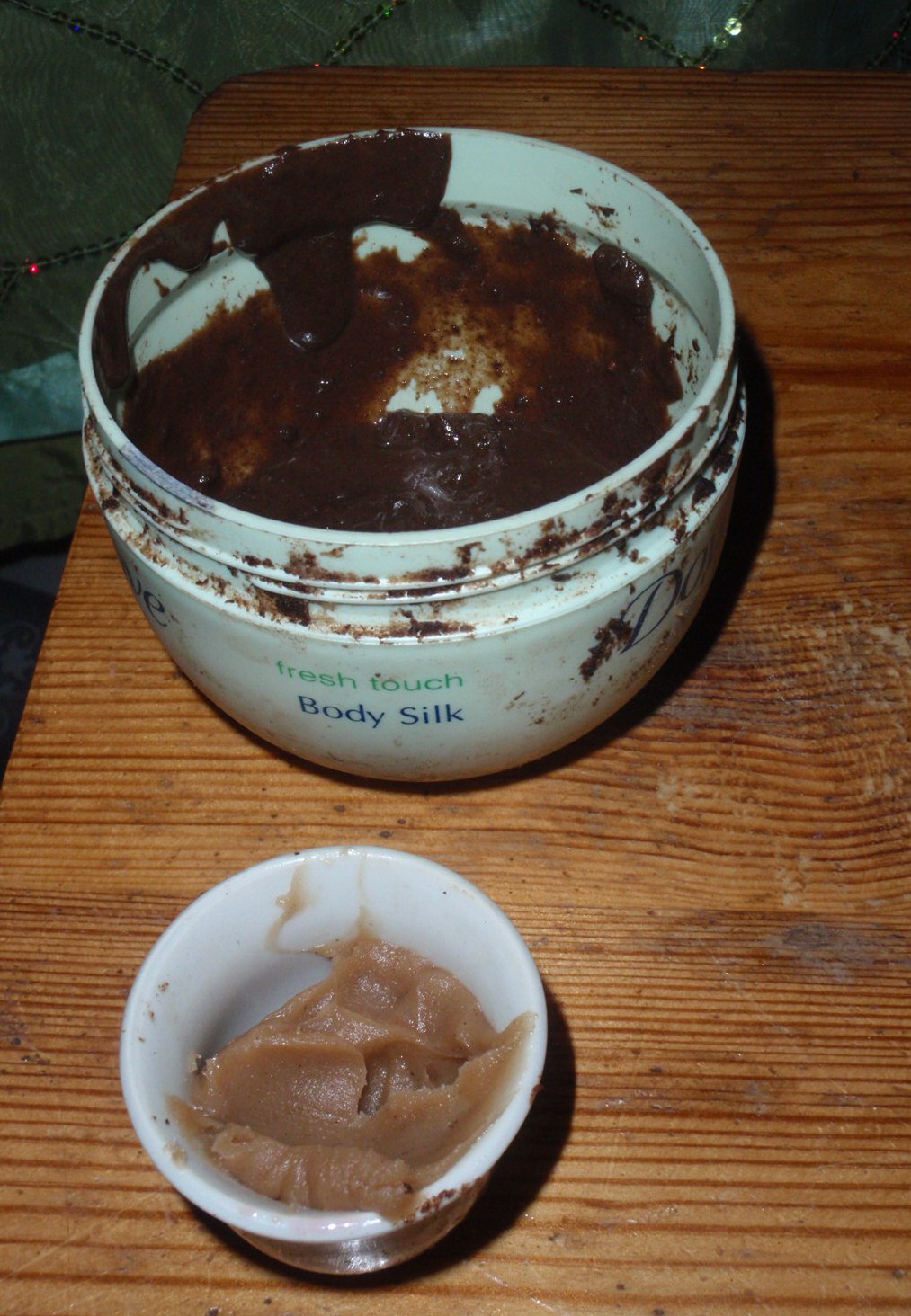 |
| Dilka and deeheen ready for use |
Used as an exfoliant, women mix the dilka with a small amount of water and
rub it over the body, removing any residual paste with deeheen –
an oily cream made from animal fat and perfumed using sandalwood oil or orange peels
dried and boiled until the water evaporates. Performed regularly, the procedure is said to help
women maintain clean, supple, fragrant and healthy skin.
Leila says perfumes
and other beauty rituals are used by women after childbirth largely for
rejuvenation purposes, as well as to mask the smell of breast milk and remain
sexually attractive to their husbands.
The alluring musky smell produced by such beauty treatments,
particularly dokhan in which women
smoke themselves with fragrant wood is enough to drive the average Sudanese man
“crazy” with desire, I’m told.
“Sudanese men like
their ladies very much when they do dilka.
This because it make their skin more soft and smell beautiful. The lady become
even more lovely and the man he come to her,” Leila explains before they both
collapse in a fit of giggles.
As well as cleansing
their bodies, Sudanese women also purify their home after childbirth by burning
bakhoor – a fragrant incense made
from soaking small woodchips in sandaliyya
(sandalwood oil). The wood is burnt over charcoal in a traditional incense
holder, with the thick musk-scented smoke seen as a way of restoring purity and positive
energy in the home, as well as give blessing for the birth of a child.


