Wednesday, December 12, 2012

Gatespotting...you just have to try it!

Perhaps it’s the lack of regular tourist “attractions” or social entertainment…but I have recently developed a rather strange liking for a new past-time: gatespotting. 

Ehhh, shinu?

What? 

In Sudan front entrances are typically marked by colourful, metal gates, bordering on the kitsch.

They feature an assortment of designs from flowers to birds, vines, hearts and other abstract shapes.

And there’s no doubt about it, the Sudanese are definitely gate proud. The general rule seems to be the louder the better.

In fact, I’ve yet to find an identical design…and trust me I’ve looked at quite a lot of gates.

They make for an incongruous splash of colour amidst the mud-brick houses of Ed Damer, which seem to have sprouted out of the brown, flat, dusty landscape.

These days I’ve developed the habit of getting off the bus a couple of stops early or detouring on my walk home from work just to discover new designs.

It’s also been a good way of discovering new corners of the neighbourhood, not to mention amusing the locals, who are not exactly in the habit of going out for a stroll just for the sake of it.

I practice my pidgeon Arabic with the curious kids who sometimes follow me, while turbaned men on depressed looking donkeys wave as I pass.

Everyone always asks where I am going. They can’t believe that I am just wandering without an actual destination in mind.

Could this new past-time take off or do I just have too much time on my hands? *Discuss*

In any case…here’s a selection of my discoveries…


Home sweet home... and the best gate of all! ;p


Tuesday, December 11, 2012

Handicrafts and heartache

Henna set
I was invited to go along to the Ed Damer branch of the Society for Progressing Women in Communities today by a local volunteer teacher at one of the girls’ schools in town.

Ahmed - a former university lecturer - has a rather endearing habit of calling me “Miss Kate” and regularly drops none-too-subtle hints about wanting to go to Australia.

Still, he makes a lively conversationalist on Sudanese political, social and education topics.

Ahmed explained that the society was established two-years ago and is funded by well-off local benefactors.

Essentially the society helps disadvantaged women set up small cottage industries to help generate extra income and improve the quality of their lives.

They run six-month educational courses for women covering topics including religion, health, Arabic, cooking and crafts.


A few purchases
To celebrate the program’s latest graduates, the centre was having an Open Day.

Ahmed tells me that most of the women come from poor backgrounds; many are illiterate or had been married young and were unable to complete their education.

After classes finished for the day one of the other teachers - who I will call Inayat accompanies me to the nearby centre.

In a Pied Piper kind of moment, I was almost mobbed by about 40 students along the way – one even offered to carry my bag.

Dressed identically in white headscarves and pale blue abayas, the girls fired an exhausting stream of disjointed questions at me, while the bolder amongst them grabbed my hand or linked their arm with mine.

As we walked Inayat introduced me to a young student I will call Aisha.

A shy and petite girl with big dimples and broad smile, Aisha tells me she wants to be a lawyer.

Crafty chooks
She looked about 15 years old, but in fact she is 20, having recently returned to her studies.

She had been married off at 15 and given birth to two children that died in infancy. 

Her husband had since left her and they no longer had contact.

Aisha said she had decided to finish her education so that she could go to university and get a good job to help improve her family’s situation.

After hearing her story I kept glancing over at her laughing with her friends.

As I watched her I couldn’t help thinking of all the times I had complained or fallen in a heap over something relatively trivial in comparison.

After arriving at the centre I am quickly ushered into a small room.

A colourful assortment of women’s handicrafts hang from the walls and spill across tables, including beaded vases, scarfs, baskets, bags, purses, children’s clothing and other items.

Sudan in still life
A diabetic-inducing array of sweets and biscuits were also on offer.

Outside a series of still life drawings and paintings depicting Sudanese village life hang on the wall.

Ahmed diligently provides detailed commentary about the pictures and individual artists.

By this time, the embroidered bags and colourful knit purses are making my bag addiction hard to suppress, but it’s hard to browse given the sheer volume of students crammed in and still shadowing my every move.

My eyes linger a moment too long on a small beaded purse and a slender woman in a lavender tobe steps forward and offers it as a gift.

Nurah, who speaks a smattering of English, is from Atbara and has three children.

I feel embarrassed to accept, but she insists and tells me to come back anytime.

Ahmed tells me that the women want to hold regular handicrafts markets in the area, but are waiting on some kind of official permission.

Crafty lovelies
He swiftly produces a notepad and pen and tells me to write my impressions of the centre and any suggestions I might have.

I’m still not sure, what benefit my insights can bring, but I admire their enthusiasm.

On my way out, the ladies load me up with small trays of sweet cakes and butterfly-shaped biscuits, which they are selling for 1 pound (17 cents) a piece.

I also stop by Nurah’s table again to buy a red-knitted purse that catches my eye.

Intayat, who has been patiently waiting to accompany me home, invites me for a guava juice at Ed Damer’s heavenly sweet shop El Bashayer.

She waves away my apology for delaying her return home and tells me that the time she passes with me is like no time at all.

I want to hug her.

Knitted purses
Later she invites me to join her for dinner at her in-laws house - a sparse, mud brick affair with a few beds, a goat pen and rusted household junk.

Almost every item in the kitchen drawers and shelves is caked in a thick layer of dirt.

I’m having an inner hygiene freak-out moment as it is before I even I spot the swarms of flies hovering over discarded meat bones and a half open watermelon.

Inayat's husband shows up later – a brusque man who completely ignores me at first and then strangely asks for my phone number in front of his wife.

His name means honest, she explains later by way of introduction/explanation.

“But he is not honest.”

The quiet bitterness in her comment catches me off-guard.

Bags, bags!!
Later, while I am helping her in the kitchen she reveals that her husband of 12 years is planning to marry a second wife at the end of the month.

She says that after the marriage he intends to live with his new wife and will visit her and the children only on occasion.

She concedes that although multiple marriages are part of Islamic custom, she cannot reconcile with his decision.

She says she keeps the deep sadness she feels inside hidden and tries to take solace in work and prayer.

Still, she tells me she is desperate to escape her unhappy marriage and would like to migrate to another Arabic speaking country, but is worried about losing her children.

“I really loved him and he loved me, I think, but now what is left?”

She stirs the potatoes and her question hangs in the air – unanswerable.


Tuesday, December 4, 2012

Medically challenged


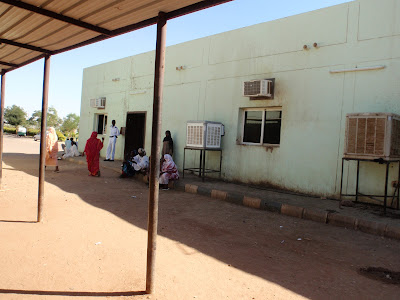
Ed Damer Hospital
Not to exaggerate my near demise in the north of Sudan ... but let's just say it's been a long eight days.

It started out as a typical upset belly and I dismissed it as being something I ate.

Over the next few days I was stuck in bed and unable to attend classes due to severe stomach cramps that made it almost impossible to stand up straight.

I would shuffle back and forth between the sitting room and the kitchen, doubled over and hair askew like a housewife gone to hell.

 ... I lost my appetite and my momentum.

The neighbours stopped by with cups of mint tea and kindness, but still it didn't pass.

I began research possible causes online, which bought up a long list of possible bacterial suspects, including the rather nasty sounding Helicobacter Pylori bug.

When I complained about my symptoms to my friend Rahel she announced she was taking me to hospital.

I'm not going to lie, an African hospital immediately inspired horror images of dingy, roach infested wards.

This image wasn't helped any either when Rahel informed me that the doctors at the hospital were not at the best time of their careers.

In truth, it looked as though people had turned up at the hospital for a social outing rather than because it was medically necessary.

White turbanned men squatted in the shade drinking tea and chatting, while on the other side women in traditional tobes greeted each other in typical Sudanese style - tapping the shoulder and then shaking hands.  

The women's colourful clothing adding a splash of colour to the otherwise drab surroundings and dirt-caked hospital walls.

We entered a nondescript room and Rahel translated my symptoms to a young, female doctor and without any further examination or consultation, she ordered a round of blood tests.

This involved me sticking my bare arm through a small slot in a window and a nurse stabbing at my forearm.

I squirmed and yelped while the lady manhandled my veins. Embarrassingly a line of people waiting behind were there to witness my lack of bravado.

Afterwards, Arm Stabber cackled loudly and suggested a tour of the hospital while we waited for the results

Who is she?

Where did you find her?, came the incredulous whispered enquiries as we passed through the corridor.

The hospital grounds comprise of the mud-splattered main building, thankfully cheered up by a small front garden lined by palm trees. 

We find a cafeteria located to the back and a dusty outdoor waiting area running parallel to the entrance.

It wasn't immediately clear, however, what people were waiting for exactly, as no-one seemed to be in pain or even in any particular hurry.

Women lazed on benches or on the ground, while nearby a family picniced together on a straw mat.

We snuck in a back door that was marked 'No Entry' and were greeted by a towering guard, who immediatley took on the role as tour guide.

Dressed in a white turban and flowing jellabiya, he had an imposing presence and a booming voice that echoed down the empty corridors.

Setting a brisk pace, the guard pointed out the specialists' offices, as well as the surgical and maternity wards.

The equipment and procedures were somewhat old-fashioned and haphazard, but the hospital itself was clean and well-kept in sharp contrast to my earlier visions.

Half-way down the hall the guard suddenly lowered his voice and quietly enquired about my marital status to Rahel.

When she translated for me, he roared with laughter, giving me a hearty whack on the back that in my newly emaciated state nearly sent me flying down the corridor.

He finished the whirlwind tour by parading me in front of a group of exhausted looking new mums, apparently unperturbed that one was in labour on the bed, before giving me another hearty whack on the back in farewell.

My tests were negative for malaria and typhoid and when I return to the patient's room with my results, I find two new doctors inside.

One says it could be the helicopter err ... helicopbacter thing, while the lady doctor declares it's gastro and promptly leaves the room.

Again there was no examination, although one advises me to drink milk - specifically cold milk and only in the evening.

In the end they send me home with a packet of meds that cost 2 pounds (about 35 euro cents).

Two days later I was at the house of Fadia and her husband Abdul Raheem for lunch only to collapse immediately following the meal.

It was at this point that I was truly grateful for the Sudanese custom of having beds, rather than couches in the living room.

Poor Fadia had to suddenly contend with a groaning, immobile house guest that kept dozing off.

She covered me with a sheet and did her best to take my mind off things with mint tea and discussions about literature.

Instead of the usual handshake, I hug Fadia goodbye as I'm leaving - partly because I'm having standing up straight and partly because I'm so grateful for her mothering and kindness.

The following day Fadia and Abdul Raheem pick me up and take me to a private clinic in Atbara that was recommended by another SVP volunteer.

Ambulance at the ready
The clinic is run by the softly spoken Dr Wadia, the former Dean of the Medical faculty at Camboni College, who is also a supporter of SVP. 

His friend Dr Safiah, who is the current Dean, is also there.

They both speak near flawless English and have a friendly and reassuring approach - although I start to have a nagging concern that my 'condition' isn't nearly serious enough to warrant the attention of two medical deans.

They perform an examination, as well as a series of tests - which all come back negative - and refer me for an ultrasound.

Before leaving the clinic, I knock on Dr Wadia's office door to thank him and enquire about payment.

He looks up from his notes briefly and raises his hand, saying simply: You are our guest.

I am both humbled and touched by Dr Wadia's kindness. In fact, his gesture leaves me lost for words at the time.

I can't help thinking how unlikely a similar gesture would be repeated in Australia or other parts of the Western world.

Likewise, Fadia and Abdul Raheem gave up hours of their time to make the 24km round-trip from Ed Damer twice in one day - first to the clinic and then back again in the evening where we waited hours for an ultrasound appointment.

I can honestly say I have never experienced such genuine kindness, hospitality and generosity anywhere else in the world. It is a rare quality and a beautiful aspect of life in Sudan.

Oh...and the diagnosis in the end - gastritis brought on by the anti-malarial meds I was taking.

Turns out news of my medical woes has also been doing the local gossip rounds, with teachers at the various schools Rebecca and I teach at already well-informed about my diagnosis well before I returned to work.