Showing posts with label Abdullah Tayib. Show all posts

Sunday, November 18, 2012

Life in Ed Damer so far


Our courtyard

A home away from home

Our home in Ed Damer is a simple, yet comfortable sanctuary surrounded by mud brick walls, with a wide verandah and white-washed arches that lend a certain colonial elegance.

A hardy tree and several henna bushes also add an unexpected splash of green to the otherwise bare courtyard.

There is one tap in the bathroom, but water is only switched on at certain times of the day, so to ensure we have enough to keep us going, we fill a large barrel for use throughout the day.

Tap water...after boiling
These days I use a bucket for almost everything  - from showering, to flushing, laundry and washing up.

The water supply is pumped directly from the Nile and is brown in colour, with a slight muddy consistency, even when boiled. 

The locals say it’s safe to drink, but I’m not too keen to risk it.

Ed Damer itself is a biggish town with a village feel that on the surface seems rather unremarkable.

Wide dusty streets comprise of a series of low-level interconnected mud-brick houses distinguished by the brightly coloured metal gates so typical in Sudan.

There is little in the way of restaurants, cafes or entertainment. Even the omnipresent tea ladies so common in Khartoum are hard to come by.

Railway tracks cut through the centre of town, with a modest brick structure marking the station. The bustling rail industry during British colonial has long since faded and passenger services no longer operate.

The rhythm of life here beats at a constant and unhurried beat, driven by the ties of family, duty and faith.

Nights are mostly quiet and uneventful here, except for the distinctive braying of donkeys.

My bed, with improvised net
I sleep outside on the verandah under my mosquito net – and although it’s winter in Sudan at the moment, you’d hardly know it.

As I watch the stars just before falling asleep, I sometimes get the feeling I’ve fallen off the edge of the world.

Our neighbor and alarm clock every morning is the local Suhaili mosque next door, which sounds the morning call to prayer at about 4.30am each day.

Ed Damer sits on the Nile and this is undoubtedly the town's jewel and lifeblood, with the famed river's clear blue waters flowing through fertile farmlands on its way north to Cairo.

There is something majestical about watching the sunlight reflect off its glimmering surface as men in white jalabiyas walk stroll along its banks with donkeys in tow.

When cultures collide

I’m yet to start teaching as it has been a holiday since my arrival and my timetable arrangements are also still being decided.

Rebecca has introduced me to some of the local English teachers at a nearby girls’ boarding school.
Local ladies
They are enthusiastic and welcoming, although their language abilities are limited.

I find myself experiencing a collision of worlds when a discussion begins about polygamy. 

For me the idea is unthinkable, but the women here are pragmatic.

As the head of the English department explains, while ladies certainly don’t like sharing their husbands, under Islam men are permitted up to four wives and if their husband decides to take another woman as his wife it is their duty to accept it.

Later the conversation turns to life in Ed Damer. I ask one of the young ladies about a camel market I have heard about it, and her eyes widen in surprise.

Women aren’t allowed, she explains, it’s only for men. I ask if I can go if I am accompanied by a local man, but she says even that is not permitted.

Girls' boarding school
In fact I soon discover that women are not allowed at any of the markets – with the exception of the ladies souk on Saturday.

If women need something during the week they must send their husband or a male relative to fetch it.

This seems ridiculous given that women in Sudanese households manage all of the cooking and domestic chores.

I can't imagine Sudanese men have a particular love of grocery shopping either.

The teacher also tells me that as a young, unmarried woman she never goes to the souk herself, sending instead her mother or sister in her place - even on Saturdays.

Market handicrafts
She recommends I do the same myself, although I’m not sure of how the logistics of that would work given that my mother isn't exactly living in the same neighbourhood.

When I ask the young lady why she doesn’t go to the market to get the things she needs herself … she shrugs and says that’s the way it is.

I bite my tongue at the time….but I still can’t completely shake off my feeling of annoyance at what feels like an imposed restriction on women from going about what is essentially a normal daily routine.

My Sudanese family

Fadia and her family have taken us under their wing since our arrival in Ed Damer and have been very helpful in settling us into our new home.

Their house opens out onto a lovely green courtyard and has a comfortable, lived-in feel.

The Nile in all its loveliness
Fadia's children Sheza and Ali also speak English and have been very welcoming. I feel as though I have already started to consider them my Sudanese family.  

They invited us for lunch at their home on the weekend, and we passed a lovely afternoon that turned into evening as we sat chatting, drinking iced karkade  (a sweet drink made from hibiscus flowers) and milk tea.

After lunch we set out for a short walk through the neighbouring farmland to the banks of the Nile. Along the way we bump into some local brick builders, who oblige by posing for a photo.

We reach the Nile just as the sun is setting. It’s a beautiful site as the orange and pink hues converge and sink below the horizon.

The moon is nothing more than a thin sliver and Fadia clasps her hands in front of her sends a short prayer into the sky, a special hadith said at this time of year to mark Al-Hijra (the Islamic New Year).
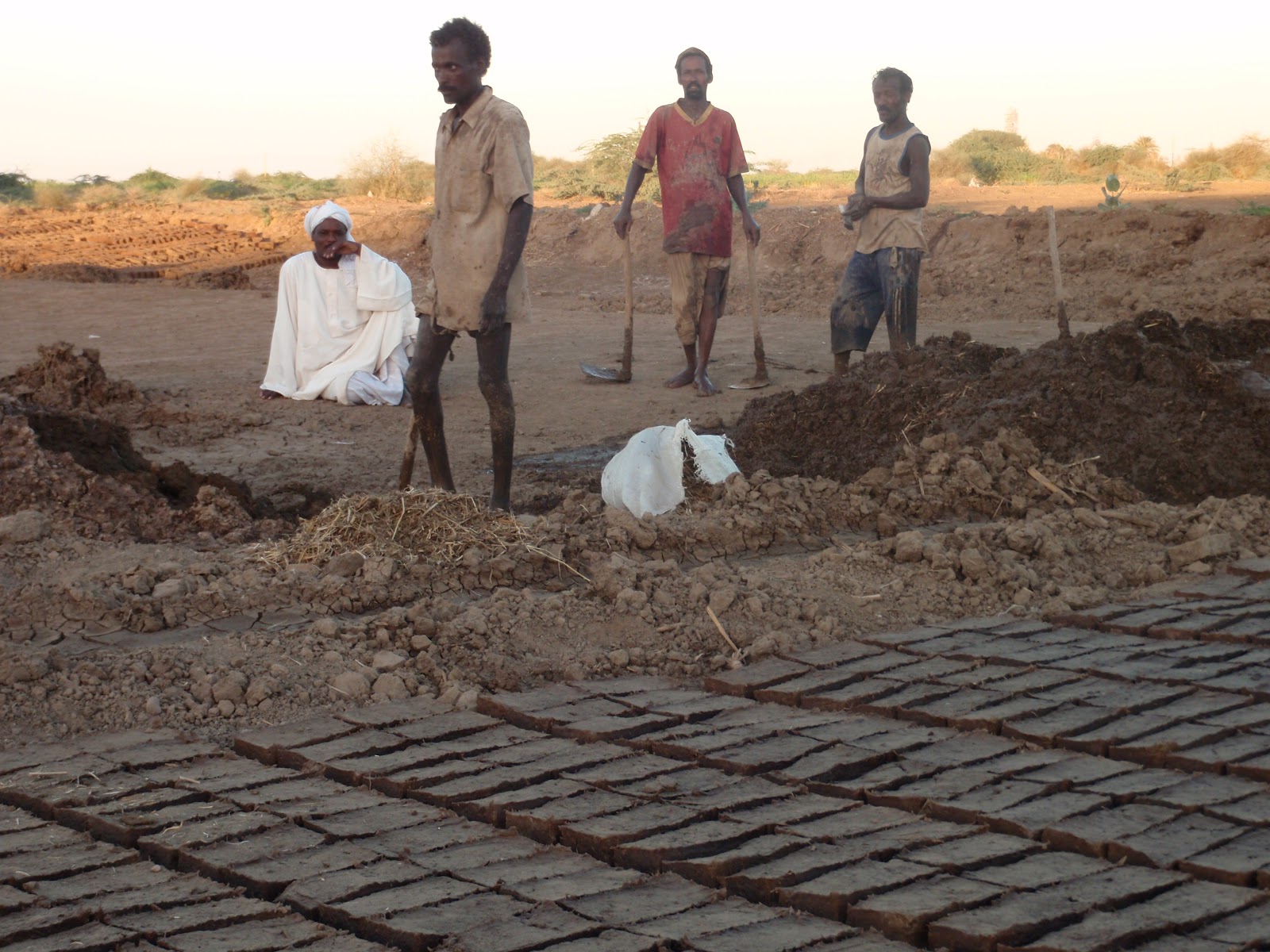
Local brick workers
When we return Griselda recites a limerick verse she composed for me while we were out concerning my encounters with the vagaries of Sudanese bureaucracy. 

It’s the first time someone has written a limerick for me and I’m quite chuffed to say the least.

The following day we picnic on the banks of the Nile a short distance from home. 

I play marbles and Scrabble in probably the first time since high school and somehow manage to fail convincingly at both.

Fadia also takes us to the ladies souk to shop for weekly supplies. It’s a noisy, assault-on-the-senses, but easily laid out with all the essentials. 

Fadia helps with bargaining and I memorise the prices of things so I can try out my own negotiating skills next time.

I’m still pretty shy when it comes to bargaining, but it’s a way of life here, so it’s something I’ll just have to get used to.

Picnic by the Nile
The traders are wide-eyed to see Griselda and two other Khawajias (foreigners) wandering amongst them and words soon spreads around the souk like a game of Chinese whispers. 

Of course everyone wants to know what we are doing and why we are here.

After the hustle and bustle of the souq Rebecca plays us all a tune on her viola back at the house. 

There are tears in Griselda’s eyes at the end as she tells us how much her late husband would have loved to have been here to hear music played in their home and how glad she is to see it come alive again.

On the wall hanging opposite us a portrait shows a reclining Abdullah Tayib laughing and relaxed, so in some way it feels as if his presence is here after all.


Thursday, November 15, 2012

“You're not in Paris, you know!”

The streets of Paris ...?
After almost a month in Khartoum, my paperwork is all finally in order and it’s time to move on to Ed Damer and what will be my new home for the next seven months.

There are some nerves about what I can expect there, but I’m also looking forward to settling in and being able to unpack after living essentially a transit lifestyle for more than three months – first in Rome and then in Khartoum.

Ed Damer is the capital of the River Nile State in north-eastern Sudan and about 300km from Khartoum. 

It lies across the bridge from neighbouring city Atbara, which sits at the junction of the Atbara and Nile rivers and was once the centre of the Sudanese railway industry, which has now fallen into decay.

Home away from home
I made the trip to Ed Damer by bus with Griselda – the British widow of famed Sudanese scholar Abdullah Tayib who has kindly offered her vacant house for me and Rebecca’s use during our stay in Ed Damer.

Now in her 80s, Griselda has lived in Sudan since the 1950s and is somewhat of a minor celebrity here.

While we were buying bus tickets, locals snapped photos on their phones and watched on half in amusement, half in open admiration as she fired off orders to her entourage in rapid Arabic.

She might rely on a walking stick to get around, but there was nothing feeble about her scathing dismissal of the hawkers stubbornly haranguing us.

“Isn’t this just ghastly?” she says with posh British aplomb as she cuts a pass through the bustling marketplace and we board the bus. 

Despite the madness and chaos at the bus station, the journey itself was surprisingly civilized.

There’s perfumed air conditioning and light snacks and drinks were even provided. 

Farmlands around Ed Damer
Admittedly, there were some genuine moments of terror - most notably when the bus swerved - not once, but twice - to avoid an oncoming vehicle.

At this point rather than slowing down, the driver inexplicably accelerated, causing the bus to lurch dangerously off-road and almost tip over.

There were also several stops along the way for the men to pray and pee (women must hold on) and in the end it takes about five hours to cover the 300km distance.

Griselda is a lively conversationalist nevertheless and keeps me entertained me with stories of her and her husband's early life, as well as pointing out archaeology sites and other points of interest along the way.

The terrain for the large part is unrelentingly flat and dusty – empty except for a few nomadic goat herders and the spindly low-lying trees that somehow survive in the harsh desert environment.

The junction of the Atbara and Nile rivers
Later, some remarkable rocky outcrops break up the flatness of the landscape and the scenery becomes more dramatic.

As we pass close to the Meroë pyramids, orange-hued sand dunes rise out of the desert and the road suddenly cuts briefly through a small mountain pass.

Griselda’s niece Fadia and her husband Abdul-Raheem are waiting to pick us up at the station in Ed Damer.

It is already starting to get dark when we arrive, but in the distance I can see the familiar gait of camels moving nochalently across the shadows, as well as the distinctive tents of the nomadic tribal people scattered along the outskirts.

As we drive towards the town centre, Griselda turns to face me in the backseat: “So Katie, what do you think?” she asks gruffly … “You’re not in Paris, you know.”

Saturday, October 20, 2012

Black markets & Sudanese high life


A visit to the black market money changers to switch some euros into local Sudanese Pounds is a must soon after arriving in Khartoum. 

Due to U.S sanctions there are no international ATM machines in Sudan and nor can credit cards be used, so the only way to get money is to bring it with you or have it wired via Western Union. 

A flourishing black market has thus sprung up, due largely to the uniformaly bad rates offered by local banks for foreign currency.

I had visions of surreptitiously haggling in narrow back streets, but instead Rami lead me into a local clothing store in the nearby Souq (market), before promptly disappearing into a back room along with my cash. 

Soon after I was also called into the room and handed a rather large wad of money to count. Watching on was a row of rather stern young men drinking tea, along with an elderly gentleman, who presided over a small battered safe at the back of the room.

Of course, anyone that knows me will be aware of my complete and utter lack of any mathematical skill, so no surprises then that I was struggling to come up with a final total under such heavy scrutiny. Luckily no-one seemed in a hurry to finish their tea.

During the day I also chatted with the other volunteers, who like me are staying at the flat while their placements and paperwork are finalised.

I also meet Rebecca, a wonderful English lady who gave up her houseboat on the Thames to come and teach in Sudan. She has already been teaching in Ed Damer (where I will be placed) for a few months, so we will be working together.

Later that day Kit - a former SVP volunteer - who is now a trustee, took Rebecca and I to meet long-time SVP supporter Griselda.

A well-known British matriarch and widow of the famed Sudanese scholar Abdullah Tayib, Griselda - who now resides in Khartoum - has kindly offered Rebecca and I use of her vacant flat in Ed Damer rent free.

This news is a huge relief, particularly for Rebecca, who has been enduring some rather unsuitable accommodation arrangements since arriving in Ed Damer.

Arriving at Griselda's, our group is greeted at the front gates by her niece Fadia, who lives in Ed Damer with her family. This warm and friendly woman immediately offers to take us under her wing once we arrive.

Decorated with Griselda’s artworks depicting famous Sudanese landscapes, as well as various collectables from the couple’s travels in Africa, her home has a cosy, bohemian feel. Air-conditioned and spacious, it is also a welcome oasis from the heat and chaos outside.

Fadia serves chilled hibiscus tea and traditional Sudanese sweets in the lounge, while we chat to Griselda about the arrangements in Ed Damer. 

A formidable and articulate woman, Griselda, who is now in her 80s, has a feisty sense of humour and shares some wonderful stories of her early life in Sudan and the many colourful characters she has met over the years.

An artwork by Griselda showing a tea lady
We also meet Hugh, an affable former barrister from Sheffield, who is on his second teaching assignment in Sudan with SVP.

As Griselda serves us cake and tea on matching fine bone china, I rather feel like I’ve stepped into a scene from a high society English tea party. She is at pains to point out that there is real milk (somewhat of a luxury in Sudan where powdered milk is more commonly served).

As we say our goodbyes later to Fadia and Griselda, Kit and Hugh ask me if I want to accompany them to their meeting with a prominent Khartoum businessman, and another local SVP supporter.

I’m still buzzing from the wonderful afternoon tea at Griselda’s when we arrive at Mahmoud’s house in the posh Khartoum 2 district.

I’m gob-smacked when the gates open to reveal a luxurious yellow mansion, set within immaculately kept gardens and surrounded by palm and orange trees.

The maids bring grapefruit juice in fine crystal glasses, followed by tea (with real milk, of course), homemade cakes and finally delicious Lebanese coffee.

The evening takes another surreal turn when talk turns to Mahmoud’s business interests and he begins to tell us how a chance meeting in Kuala Lumpur with an official there resulted in him later being appointed the Honorary Consul of Malaysia in Khartoum.

At the time, Malaysia was keen to expand their oil interests in Sudan, however, the North-South conflict continued to impede further development.

We all listen intently as Mahmoud goes on to explain how he managed to broker a top-level meeting between Malaysian government officials and then South Sudanese rebel leader John Garang, despite, he said, having no political connections.

Ever the gracious host, Mahmoud offers to drive me and Hugh home after the meeting, but before that he takes us on a short tour of his street. 

Along the way he points out several luxury properties that he also owns, including a split level rose-coloured home complete with swimming pool that is rented by his son and a palatial white mansion currently rented by the Swedish ambassador to Sudan.

When I return to the SVP flat, I find the other volunteers sitting in the crowded living room, empty take away containers lie discarded on the table … and just like that my brush with Sudanese high life abruptly comes to an end.